• Skip to content

primary

  • about
  • projects & exhibitions
  • collaborate
  • connect
  • Back
  • biography – c.v.
  • statement
  • writing
  • Back
  • M(y)otherwork
  • Resurfacing
  • Into View
  • Back
  • commissions
  • teaching
  • residency

corynn kokolakis - toronto

primary

  • about
    • biography – c.v.
    • statement
    • writing
  • projects & exhibitions
    • M(y)otherwork
    • Resurfacing
    • Into View
  • collaborate
    • commissions
    • teaching
    • residency
  • connect

Header Widgets

Collected Writing

A selection of critical, curatorial, and personal writing produced alongside the practice — from early reflections on returning to painting, through academic work completed during my BFA and MFA, to exhibition texts written for others. The pieces are published in the order they were written. Taken together they trace the thinking and the looking that underpins the work.

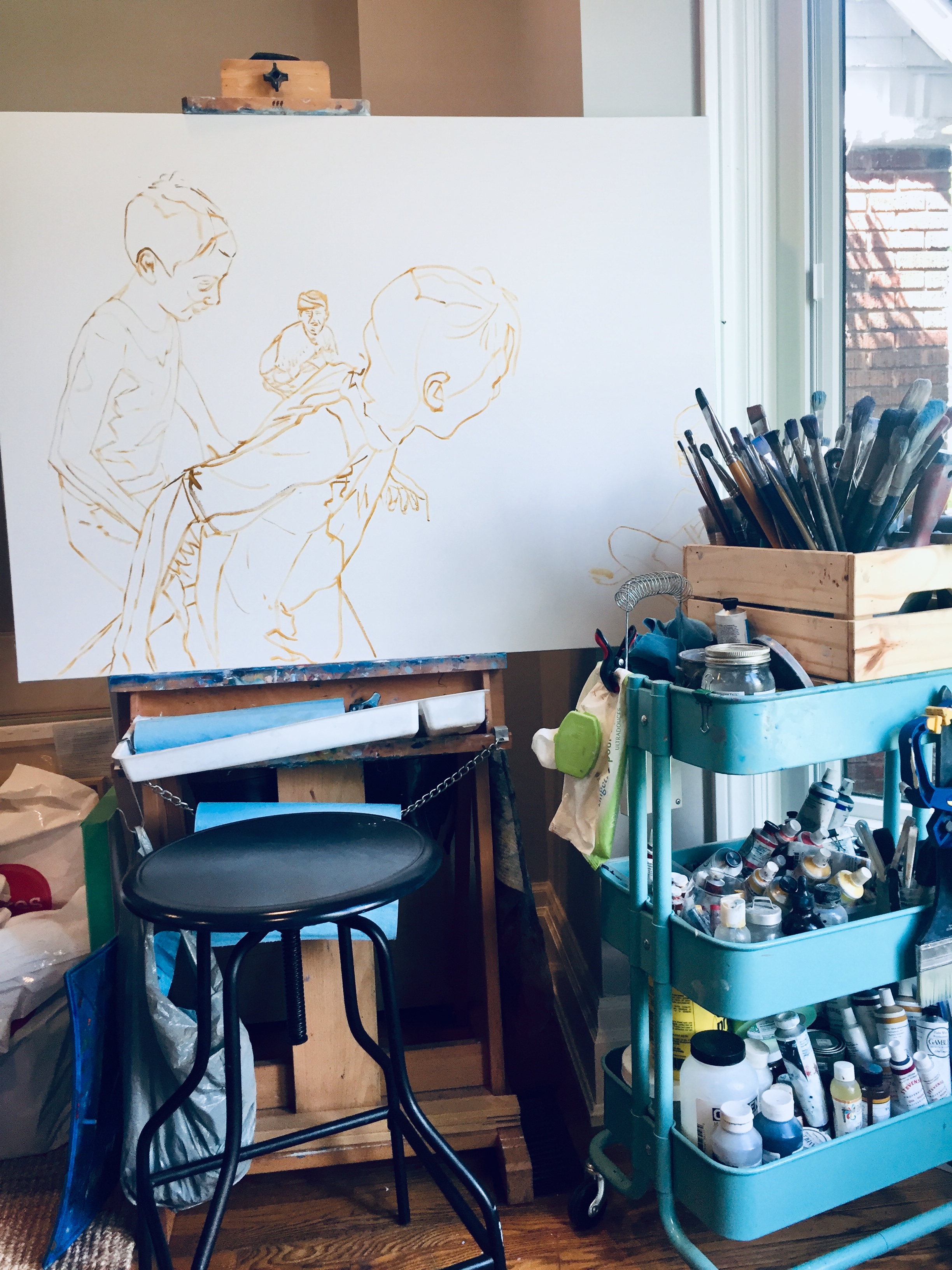
Repositioning the Gaze: An Aesthetic of Care

Master’s Thesis – Repositioning the Gaze: An Aesthetic of Care

Abstract:

This paper explores, from the subjective positions of mother and figurative painter, the connections and incongruences between the practice of painting and the care practice of mothering. It considers the temporal de-calibration that occurs when engaged in the processes of both practices to shift the focus away from a timely, finished product. Through embodied and autotheoretical lenses, it argues for a reconfiguration of the gaze to look outward from mothering in order to emphasize practices of attunement. It contemplates how artwork might make publicly visible the maintenance and emotional labour of being alongside an other, and posits that painting can be positioned as a form of documentation for the mostly invisible parts of mothering. It considers how engaging with paintings created from the perspective of those who practice care might trouble the boundaries between art and life, public and private, practice and product, and artist and mother.

Full Text

Bind, Exhibition Text

Bind, Special Projects Gallery, York University, Toronto,  Feb 6-10, 2023

Exhibition Text written by: Corynn Kokolakis

Bind: An exhibition of works by Corynn Kokolakis, D’Andrea Bowie & Rachael Grad, Toronto, Canada

Tethered through the emplacement and material conditions of their making, three artists explore the inherent connections and conflicts between art and life. Produced by mothers always in relation to multiple others (human and non-human) the works in this exhibition speak to the entanglements and constant negotiation required to “be with” everchanging place, materials, small humans, and the creative self. Themes of collaboration, holding, shaping, watching, and waiting are addressed with a similar focus on the material qualities of each artist’s chosen medium, drawing a line toward embodiment. In this sense artistic labour might mimic maternal labour, but as writer Eula Biss notes: “Mothers are more families than just workers, and that is the bind. We are lashed to this institution by our own attachments and desires” (xviii). It is those varied attachments and individual desires that permeate through the works included in Bind.

Rich, Adrienne, et al. Of Woman Born: Motherhood as Experience and Institution. W. W. Norton & Company, 2021.


Resurfacing – Exhibition Text

Corynn Kokolakis, Resurfacing, Leslie Grove Gallery, Toronto, Oct 27 – Nov 6 2021

Resurface – verb

re·sur·face | \ (,)rē-‘sər-fəs

: to provide with a new or fresh surface

Resurfacing—is an external exploration of surface and the material qualities of paint, as well as a reflection on a personal journey. These newest works mark a divergence in practice while remaining faithful to the subjects and threads that push it forward—growth, development, connection, and documentation spill out from the visible paint marks. Fluidity and image come together to inscribe a moment that is simultaneously an instant and a lifetime.

Water, both a physical and symbolic life force, invokes multiple congruent and contrasting meanings. Joy, fear, reflection, immersion, power, precarity, purity, renewal, movement, and stagnation are just some of the themes that emerged in the creation of this exhibition. These metaphors extend to various states of transition, transformation, and the intense negotiation with time which flows steadfast even as humanity pauses. A juxtaposition of vastness, limitation, listlessness, and possibility, the work touches on the inevitable and subjective transition through various stages of childhood while reflecting a similar shift between mother and artist.

Created in the confine and quiet imposed during the global pandemic, these paintings explore the anxiety and tension of indefinite holding in a privileged place of belonging, safety, and comfort. Exhibited now, as we begin to reconnect, Resurfacing asks us to consider what filled the space between then and now and who we might strive to become as we emerge.


Methodology, Making and Mothering

Still Not Done: Methodology, Making and Mothering York University, April 2022

The research-creation project which this text examines was initially conceived as an oil painting. The painting would be supported by frameworks previously associated with my existing body of work through textual research and academic writing — autotheory, the everyday, and the notion of in-betweenness — to consider the boundaries between life and art and what Griselda Pollock describes as the “conditions of creation.” These theoretical frameworks allow me to understand and advocate for my work from a social perspective. Still, they don’t necessarily offer insight into the specific form and function of my subjective studio practice. What are the material conditions of my mothering, practice, and research, and how do they affect one another? How does the specific configuration of my practices of mothering and painting impact, impede, or enhance my research-creation projects? I recount the implementation of various methodologies borrowed from writing and pedagogy to interrupt established paradigms and determine new ways of working and thinking about the messiness of conflicting practices. The answers to my questions may not be as definitive as I’d hoped. I suspect the reason they are so difficult to pin down is because the social and material conditions are, in fact, entangled and always in the process of becoming.

I am, in a sense, no longer just raising children; I have begun raising myself.

Download full essay PDF

Out of the Darkness, Kari Serrao – Exhibition Note

Kari Serrao, Out of the darkness, Leslie Grove Gallery, Toronto, October 1-10, 2021

Exhibition note by Corynn Kokolakis

If you are familiar with the trajectory of Kari’s practice, the offering in “Out of the darkness” is a bit of a departure. Still, it sits comfortably within her established aesthetic. Gilding and refinery are stripped away, leaving a depth and complexity that reads just as elaborate as the work for which we have come to know her.

Yet one does not need to contrast this work with anything but itself to find resonance. The exhibition is ripe with elements that relish their differences while coalescing into symbolic touchstones, guiding us forward.

The hare, a constant in her practice, is rendered in encaustic; the anthropomorphic quality is heightened through the depth offered in the naturalistic backgrounds, which seem to move around to embrace the subject. Though reminiscent of Durer’s depiction of the hare as object, these figures have agency and are anything but “still.”

One can detect whispers of the traditions of Dutch Still Life in the handling of light that defines the exhibition. Peonies, delicate, moving out of the darkness, become a sort of “memento mori,” a notion that what is not preserved is bound to be lost. Yet, there is also a sense of rebirth in the blooms that have no outside edges, flattening while simultaneously offering a glimpse of the infinite—possibility, perhaps, in precarity.

This flatness and possibility intertwine throughout the work, and it is in the pieces where natural elements meet the figure that the shifting picture plane and handing back and forth of medium become most apparent. The hare painted just as adeptly in oil appears again alongside the raven. Merged with petals and rock striations, the animals, symbolic guides, elude to a grounding in the natural world—a call to return to something foundational.

It would be challenging to avoid inserting the implications of the pandemic in the reading of this work. And in her statement, Kari speaks of personal upheaval as the impetus to its making. But what she has shown here is perhaps a glimmer of the zeitgeist of the last two years. Fragility, quiet, darkness, grounding, authenticity, hope, movement, light, and ultimately, growth are universal.

So let’s talk.

(Bell Let’s Talk Day, January 2020)
Somewhere between about 25 and 37, I got lost. I made my way along that strange path well enough. I would say successfully, even.
Until I didn’t.
This isn’t an unfamiliar story. Young woman becomes mother, loses self. Aren’t we all the Martyr in some way at some point? The thing is. When you are lost like that, you are often alone. You may surround yourself with other lost souls, and for a time, being lost together makes it bearable. Maybe even fun.
Until it isn’t.
Eventually, the path becomes submerged, and you begin to tread water. One day I got tired of treading, I was drowning. Someone who had once successfully pulled herself up from the same depths threw me a life vest. She said, “do one thing JUST for you.” The ONE thing I could remember that was all mine, and mine alone, was painting.
And so it was. I’ve called it my snorkel.
My return to it came quickly and fiercely. It allowed me to breathe deeply enough that I began to see a path that I recognized.
Now, by what seems like a miracle, I can see where I’m going. I can look at a map. I can be where I want to be. I am finding my way.
One brush at a time.

I got lost in a balloon!

Well, not actually. But maybe, metaphorically. There hasn’t been much production from me lately. If there really is such a thing as a muse, mine was off gallivanting somewhere else. More likely, it was my own gallivanting that got me into trouble.

Partly out of necessity, and partly by choice, I took a month away from painting. I spent the first half of October preparing my family before I ran off without them. I spent a blissful two weeks driving along the coast of California, ballooning over the vineyards of Napa Valley, and contrasting the serenity of the California desert with the intensity of Las Vegas.

It was an amazing adventure, and in truth, it was the first time I’d “flown solo” for any significant length of time. I expected to come home with a head filled with new work that would spill out onto the canvas. I was wrong.

It was a full six weeks, and I’d hardly touched my brushes.

I wondered if the muse had abandoned me, but it seems it was I who left. My family has always been my inspiration, my work, even when unintended, speaks to the everyday juggling that comes with raising them. Apparently, I need that chaos in my life to find the quiet in painting. So just in the last few days, after nearly two full weeks back at home, my brush finally touched canvas.

It was lovely to spend time away from them, but as it turns out, I’m only whole when they are making me wish I was back up in that balloon.


Space – on the necessity of a room of one’s own

I sat down with someone at Akin studios and promised them a quote about my new space. I spent a good part of the day trying to think of a brilliant statement that would shine on social media. But space is so much more than a catchphrase.

At this stage in my life space is a luxury, one that I rarely, if ever take for myself. But spending these first few weeks in my very own studio away from home, outside of the academic setting has offered a glimpse of something I’d simply forgotten. And I’m not talking square footage.

What I’m learning is the distance that space offers can facilitate self-discovery. Ideas come like waves in the quiet of space. And you can ride them onto shore then back out again. Eventually, these ideas seem so familiar that you realise they’ve always been with you, waiting in a shadowy corner to be pulled out, dusted off and placed on display.

In my writing at school, I talked about Virginia Wolf’s thoughts in A Room of One’s Own, and while I still believe she is bang on, and that the path toward greatness exists in these dedicated spaces of female creativity, greatness isn’t really the point.

We shouldn’t justify taking space through the pursuit of greatness. Stretching out of your confines is more than a luxury, it is a necessary kindness. My new space, one that I had a hard time accepting, won’t push me to greatness. But I have become greater. I think more, talk louder, care deeper.

I can feel myself growing in this space, and I may well become too much as a result. There will be bruises as I reach my boundaries. Because growth can be awkward and difficult and glorious.

This. This is what space does.

Just paint.

Praxis: the process by which a theory, lesson, or skill is enacted, embodied, or realized.

I worry. Too much. About nearly everything. Was it always like this? I can’t remember. Surely it must be another one of the resounding changes that motherhood brought. Maybe it emerged with the stretch marks and tears that come now at even the slightest hint of sentimentality.

What I do know is that when it comes to certain things, like my work, or my personal success, the worry is downright paralyzing. I used to tell myself that I was just “gearing up,” and the pressure would serve me. Indeed, that drive to “do well” has paid off in many ways. But I’m learning slowly, that especially with regards to my creative drive and the mother/artist tight rope, the pressure to do well, may be hindering “the doing.”

The words of my advisor keep ringing in my head. “Just paint,” she’d say.

As if it were that easy. There are children and a husband and laundry and dishes and snuggles with the dog.  It was determined long ago, either by choice or necessity that my life would prioritize all of these things. I put them first, but offer myself distracted.  My head is so caught up in what “might be,” it’s blind to “the now.”

“Just paint.” She’d say.

I should be painting, I worry when I’m chatting with my teenage son. It won’t be finished, I think as I fumble through the monthly bills. How can I fit the work in? What if it isn’t dry? Is it good enough? These thoughts natter away from the corner of my mind that is supposed to be engaging in self-care. So, what can I do but sit down to make a plan? The voices eventually ebb as I convince myself I can juggle it all. But I aim high and fail fast. Every single time.

It’s that fear of that failure that has me chasing my tail, in a worry/plan cycle that never ends. I’m never fully here and now. And what I’m mostly NOT doing, is painting.

“Just paint.” She’d say.

Perhaps it’s beginning to make sense? I think I might understand…

Sometimes the paintings are wet. Sometimes they are not finished in time. Sometimes I make bad work, and I talk to my kids and snuggle my dog. THIS is my life. THIS is my praxis. It doesn’t need to be any more than it is in this moment. The rest will come, or maybe it won’t. But it doesn’t matter because I think I might finally sit down to “just paint.”Just Paint

Posts navigation

Older posts

© 2026 Corynn Kokolakis - Toronto Artist - All rights reservedMINIMAL

Follow us on Instagram
x